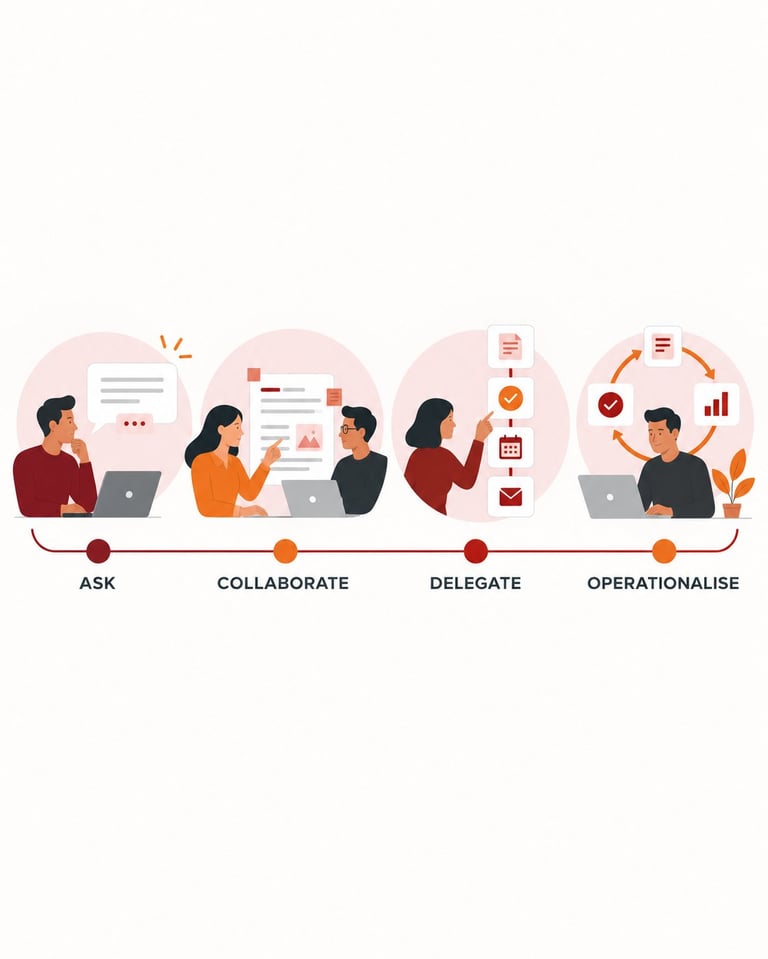
AI is no longer just about asking a chatbot a question. New tools can work alongside you, complete multi-step tasks and turn repeated work into reusable agents. This practical, non-technical session helps teams understand the difference and choose the right approach for the job.
Chat is not an outdated version of an agent. These are different ways of allocating responsibility between a person and the AI, and more autonomy is not automatically better.
More autonomy can help when work is multi-step, coordinated or repeatable.
More autonomy can also add complexity, risk and unnecessary effort.
The right choice depends on the work, not which technology sounds newest.
These are four different ways of working, not four levels of maturity. You do not need to progress through them in order, and most people will move between them from task to task.
"Help me"
Chat
A conversational way of working where the person remains the main driver of the work.
Best for
"Work with me"
Co-working AI
Human and AI work together on a substantial piece of work, with the person shaping and refining the result.
Best for
"Do this for me"
Agentic AI
AI is given an outcome and can determine and perform several steps, use tools, gather information and adapt with less continual prompting.
Best for
"Do this whenever it needs doing"
AI Agent
A configured, reusable AI capability designed for a role, task or process, combining instructions, knowledge, tools, permissions, actions and governance.
Best for
Choose the lowest level of autonomy that reliably gets the job done. A simple task does not become better because an agent performs it.
Four things usually determine the right choice: how often the work happens, how many steps are involved, how much judgement is needed and what happens if AI gets it wrong.
Need an answer, idea, explanation or short draft?
ChatNeed to build and refine substantial work together?
Co-working AINeed AI to determine and perform several steps?
Agentic AIDoes the same workflow repeat regularly?
Consider an AI AgentIf the task is high-risk, ambiguous or difficult to reverse:
A practical, non-technical session focused on business judgement. This is not a coding course, and no technical background is needed.
The session is vendor-neutral first. We teach the underlying work patterns before translating them into the tools your team uses, so the principles stay useful even as products change.
This topic can be delivered as a focused standalone session, or incorporated into a broader AI training programme. Sessions run online or in person, whichever suits your team.
A focused specialist session covering the four ways to work with AI and how to choose between them.
Included as a module within a half-day AI workshop, alongside practical application and hands-on exercises.
Built into the wider full-day AI training programme for teams who want a broader foundation.
Formats and pricing are set out in full on our AI Business Training page, so everything stays in one place and up to date.
View Training Formats and PricingThe right approach depends on the version of the task, not just the job category. These examples are vendor-neutral and illustrate the pattern.
Why: The person already has the context and final judgement matters.
Why: The value comes from iteration, challenge and refinement with the person remaining closely involved.
Why: The outcome is clear, but gathering and synthesising the information involves several steps.
Why: The task has become a stable, repeatable process.
Giving an AI system more responsibility means it can access, decide and act more. These are materially different levels of responsibility:
Some work should stay human-led. And if a task follows fixed rules every time, conventional workflow automation may be a better answer than an AI Agent.
Explore Using AI Safely at Work trainingThe training can be adapted for different levels of responsibility, and delivered to mixed groups where that suits you better.
Understand the different ways AI can support work and choose the right approach for everyday tasks.
Identify work that may be suitable for delegation, repeatable agents or continued human control.
Build a clearer view of where agentic AI may add value, where guardrails are needed and where autonomy should remain limited.
Practical answers for teams thinking about AI agents training.
The goal is not to use the most advanced AI option. It is to use the approach that gets the job done with the right balance of capability, judgement and control.